


Did you know many “near me” searches happen minutes before someone visits a store? If you’re not showing up in google near me for retailers results, you’re missing high-intent shoppers who are ready to call, get directions, and buy.
Key Takeaways
- Win google near me for retailers visibility by optimizing for both Google Search’s Local Pack and Google Maps—your customers use both.
- Start with a complete, accurate Google Business Profile (hours, categories, photos, local phone number) and keep your NAP details consistent everywhere online.
- Build review volume the right way: ask consistently, make it easy with a QR code/link, and avoid incentives that violate platform policies.
- Create location-focused site pages (hub → state → city/neighborhood) so Google can match your store to local-intent keywords and “near me” queries.
As mobile search has expanded over the past decade, Google has continued to surface more complete, relevant information for people searching on phones.
Today’s mobile results reflect how people use their devices to do more than browse the web—they use them to navigate the world around them.
That’s the rationale behind Google local results (often shown as the Local Pack in Search and results in Google Maps) for “near me” queries—a curated set of results tailored to local intent (people searching for things geographically nearby).
Think of searches like “nail salons near me” or “coffee shops near me.” That's the Google near me effect!
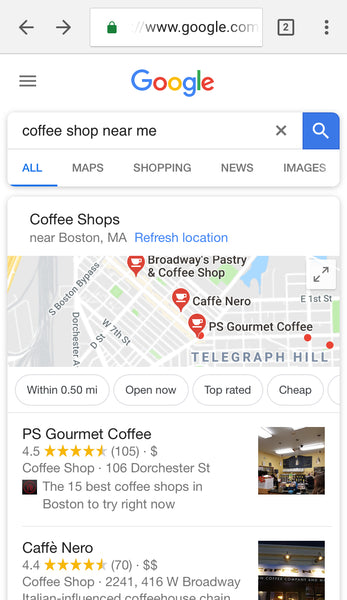
This kind of search has grown tremendously over the past decade, and it represents an opportunity for brick-and-mortar retailers to take greater advantage of online traffic.
While the most common “near me” searches are for restaurants and entertainment, every brick-and-mortar store can benefit from tapping into local searches.
Let’s talk about why your store should get listed for local intent search.
Why Do “Near Me” Searches Matter?
Mobile searches have skyrocketed over the past decade.
Google says local results are based primarily on relevance, distance, and prominence (see Google Business Profile Help).
Just look at the trendline for the search term “near me”:

Since this article was first published, Google’s local results UI has evolved (including a more Maps-first experience and prominent Local Pack placements), but the goal is the same: improve your visibility when people search with local intent.
Many shoppers use “near me” searches and tend to click top results—so improving your local presence can translate into more calls, direction requests, and store visits.
These numbers are only set to grow as mobile devices continue to expand their reach and new features (like voice search) gain popularity.
If you aren’t working to show up for these searches, there’s a whole market you’re potentially missing out on.
From introducing your brand to new potential customers to helping people find your brick-and-mortar store, there are a lot of benefits to ranking for local intent searches—and it doesn’t have to be painful to get your store there.
How to Rank for Google Near Me Searches
There are some aspects of search engine marketing that require extensive expertise or a big time investment for you to see results—but local searches aren’t one of them.
Here are three steps you can take this week to put your store in the best position to show up for “near me” queries.
Step 1: Complete and Optimize Your Google Business Profile
Let’s start with the easiest step of them all: completing your Google Business Profile (formerly Google My Business).
Your profile includes information about your store, location, and hours—among other things.
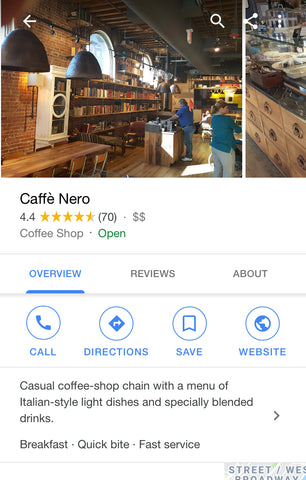
Complete profiles can help customers understand your business and may support local visibility.
Google says local results are based primarily on relevance, distance, and prominence (see Google’s local ranking guidance).
Many businesses already have a Business Profile—even if you didn’t create one—so your first step is to go to Google Search or Google Maps to claim and manage your Business Profile.
Next, enter information about your store and upload photos of your space and products.
Be sure to include as much information as possible.
You’ll also want to use multiple unique photos that will set your listing apart from other businesses.
On top of entering information and uploading photos, here are a few tips to help optimize your store’s Google Business Profile:
- Include a local number: For local searches, Google prioritizes businesses that have a local phone number over those with a toll-free (or 1-800) number. If you have both, use your local number for the listing.
- Ensure all listings share the same information: Wherever your store’s information is listed across the web, ensure your name, address, phone number, or hours are listed consistently.
- Create separate listings for multiple locations: If you have more than one store, create a unique Business Profile for each location. Use your real-world business name exactly as it appears on signage and branding; don’t add city/neighborhood keywords unless they’re part of your consistently used real-world name (see Google Business Profile name guidelines).
Step 2: Encourage Customers to Leave Google Reviews of Your Store
If you’ve used search engine marketing in the past, you know that Google doesn’t tell us outright what specific factors they consider when ranking search results.
That’s why search experts often rely on case studies and experiments to find the effect of certain factors on search performance.
When Local SEO Guide put local search ranking factors to the test, they found that the factor with the largest positive effect on local search rankings was Google Reviews.
Businesses with more Google Reviews (and, to a lesser extent, third-party reviews) and a higher number five-star ratings were more likely to show up for “near me” searches.
If your store has plenty of online reviews, you’re in good shape already.
Here are a few suggestions for how to encourage customers to leave Google Reviews for your store:
- Ask for reviews (without offering incentives): Make it easy with a QR code at checkout or a short link on receipts and Post-Purchase emails.
- Remind customers: When customers are happy, it often takes just a little nudge to convince them to review your business. Use signage In-Store to remind customers that you’d love a Google Review. Print reminders on receipts or include a note in their shopping bag. Train your staff to encourage reviews during the checkout process, too. If you collect customer emails, consider setting up an automated campaign to encourage reviews.
Avoid offering discounts or gifts in exchange for reviews, as many platforms restrict incentivized reviews (see Google’s policy on misrepresentation and incentivized content).
Bonus: Use Social Location Tags to Drive Local Discovery
Google local results aren’t the only way to tap into local intent online—there’s also a growing trend of searching for local stores and restaurants on social media.
According to The Verge (2025), Instagram has 3 billion monthly active users.
That scale makes location tags and local discovery meaningful for retailers.
Social activity can increase brand awareness and drive visits, which may indirectly support local marketing performance.
That’s why, on top of maintaining social media accounts for your store, it’s worthwhile to encourage shoppers to tag your location in their social media posts.
Offer a discount to customers who post about your store.
If you have guest Wifi in your store, consider “charging” shoppers by asking them to check-in on social media in exchange for free Wifi.
Step 3: Structure Your Website for Local Keywords (and “Near Me” Intent)
Just like regular old search engine optimization (or SEO), much of Google’s ranking decision centers around the keywords you use throughout your website copy, URLs, and metadata.
By sprinkling in the right keywords—location names, in this case—you make it easier for Google to figure out where your business is located geographically.
That bumps up your odds of ranking for location-specific searches, including google near me for retailers queries.
Greg Kristan, founder of Boston-based SEO consultancy TM Blast, recommends using a granular approach to your website’s structure:
By having a clear path that goes from [your website] hub, to state, to city, you can optimize the content by getting more and more granular with each level you go down.
In other words, by linking to more specific, location-based pages from your website hub, you pass some of your homepage’s “link juice” (or authority, in the eyes of Google) on to pages that target location-specific keywords.
That way, you can target the individual cities or neighborhoods you serve without having to secure as many external links pointing to your local page.
Taking a granular approach to your website’s structure also works really well if you have multiple store locations that need to rank for different “near me” searches.
What’s That About Securing Links?
Again, similar to traditional SEO, Google looks at both the quantity and quality of links to your website from other sites.
To search engines, those links are little hints as to the quality and relevance of your website.
That’s why a robust link-building strategy is an important part of any search marketing effort, and getting listed in “near me” results is no exception.
Since Google looks at the quality of the websites and pages that link to your website, it can be a slow process to build up relevant, high-quality links that actually boost your search rankings—but that doesn’t mean it isn’t worthwhile.
To help your store rank for local searches, try to secure links to your website that include the city or neighborhood name in the anchor text (the words you click on to open the link).
The location specific pages we talked about above come in handy here.
Get Listed in Google Local Results for “Near Me” Queries
Between smartphones and voice searches, local intent searches are poised to continue their growth for years to come.
Showing up for these searches can help introduce your store to a new and broader base of potential customers and ensure they can find you out in the real world.
By taking the three simple steps above, you can put your business in a strong position to appear in Google local results (Search and Maps) and drive more foot traffic to your store.
Read more
- 5 Lessons Traditional Retailers Can Learn From DTC Brands
- Affiliate Programs for Retailers: What Are They and How They Can Boost Your Revenue
- How to Set Up Google Maps Ads for Beginners
- The 8 Best Podcasts for On-the-Go Retail Entrepreneurs
- Hyper-Personalization: 4 Examples of Retailers Doing it Right
- How to Get Started with Google Places for Business
- Cause Marketing: What It Is, How To Do It, and Why It Matters
- How to Make Your Product Copy More Persuasive
- Social Commerce For Retail: What Is It and 3 Examples of Retailers Doing it Well
- Foot Traffic: The Ultimate Guide to Bringing More People Into Your Retail Store
Google “Near Me” Results FAQ
What are Google “near me” search results for local businesses?
Google “near me” results are a curated list of search results tailored to local-intent queries from people looking for nearby places, such as “nail salons near me” or “coffee shops near me.” They’re designed for mobile behavior where people use phones to search the world around them.
How do I optimize my Google Business Profile for “near me” searches?
Claim and manage the listing, then fill it out with complete, accurate details, hours, and multiple unique photos. Use a local phone number, keep name/address/phone/hours consistent anywhere they appear online, and create separate listings for each location. Use your real-world business name exactly as it appears on signage and branding, and don’t add city/neighborhood keywords unless they’re part of your consistently used real-world name (see Google’s name guidelines).
How can I get more Google reviews to improve local rankings?
Ask every customer for an honest review—without offering discounts, gifts, or freebies in return. Make it easy by sharing a direct review link or QR code at checkout, on receipts, and in post-purchase emails. Don’t “review gate” by only asking happy customers, and don’t pressure customers to leave a specific rating (see Google’s policy on incentivized content and misrepresentation).
Why do “near me” searches matter for increasing store foot traffic?
“Near me” searches are a strong signal of local intent—people are often looking for a place to go next. Google says local results are based primarily on relevance, distance, and prominence, so improving your Business Profile and local signals can help you show up when nearby shoppers search (see Google’s local ranking guidance).
Can my website structure help me rank for local keywords?
Yes—use location names in website copy, URLs, and metadata, and structure pages from a hub to state to city for more granular targeting. Link from the hub to location pages to pass authority and target cities or neighborhoods without needing as many external links, which can be slow to build.
Pick one action you can complete today—claim your Business Profile, add new photos, or generate a review QR code—and schedule the other two for this week.
When you combine a complete listing, steady review growth, and location-focused pages, you improve your odds of showing up in google near me for retailers results and turning local searches into real foot traffic.
Ready to connect online discovery to in-store sales? Build your retail presence and start selling with Shopify today.

