


What if you could lower holiday acquisition waste before ad costs spike? The strongest holiday ecommerce plans start earlier than most merchants expect, combining pre-peak audience building with retention tactics that protect margin when competition intensifies.
Key Takeaways
- Start holiday planning before peak shopping weeks so you can build audiences, test offers, and avoid making expensive last-minute acquisition decisions.
- Use paid social, paid search, and retargeting early to warm high-intent shoppers before holiday CPCs rise and conversion efficiency becomes harder to maintain.
- Segment existing customers by behavior, value, and intent so email and retargeting can drive more profitable repeat purchases during Black Friday Cyber Monday.
- Increase average order value with bundles, tiered discounts, and threshold-based shipping offers that make rising holiday ad costs easier to absorb.
Table of contents
- When to start holiday marketing planning
- Top holiday ecommerce concerns
- New customer acquisition
- Existing customer retention
- Your holiday ecommerce marketing plan
- Frequently Asked Questions
Plan for the holidays like 50 of the world’s top brands. In Shopify’s 2018 internal survey, this group included 50 high-growth commerce brands that shared when they started planning, what worried them most, and which acquisition and retention channels they prioritized. Use the broad patterns as directional guidance rather than current market benchmarks.
For most brands, the core holiday playbook is straightforward: start planning early, build retargeting audiences before peak CPCs, focus paid search on high-intent queries, and segment existing customers so retention channels can carry more of the load once acquisition costs rise.
When to start holiday marketing planning
Many of the high-growth brands in Shopify’s 2018 internal survey started planning their holiday marketing campaigns months in advance. The percentages below are historical survey findings, included for directional context rather than as current benchmarks.
Top five months to begin holiday planning
- September: 25.5%
- October: 19.6%
- June: 15.7%
- July: 9.8%
- August: 7.8%

While many respondents began planning in the third quarter, the broader takeaway is simple: most brands start before Q4, and some begin as early as Q1 or Q2.
Quarterly breakdown
- Q3: 43.1%
- Q4: 25.5%
- Q2: 21.6%
- Q1: 6%
That timing matters because early planning gives you more room to test creative, refine offers, and build audiences before holiday competition peaks. As one founder put it, acquisition strategy rarely stays static as a brand grows:
Our acquisition or customer awareness strategy is literally changing every day. I mean it's changed so much over the course of the company.
— Debbie Weey Mullen, Founder at Copper Cow Coffee (Source)
Top holiday ecommerce concerns
Worrying only about what matters also separates high performers from the rest.
Top five concerns for holiday ecommerce
- Rising ad spend
- Customer service needs
- Inventory
- Shipping and fulfillment
- Returns

Rising ad spend is an even greater concern when you consider that, in Shopify’s 2018 internal survey context, average order value (AOV) did not necessarily rise enough to offset higher acquisition costs.

Flat holiday AOV can result from:
- Increased competition for holiday shoppers
- Discount-driven shopping behavior
To boost AOV, consider these three holiday marketing strategies:
#1: New customer acquisition
Begin paid advertising to build your audience before costs soar, for example with a delayed-attribution model and heavy emphasis on retargeting.
#2: Engagement with existing customers
Use behavioral data like past purchases and real-time personalization to segment your users for email marketing before and during Black Friday Cyber Monday.
#3: Offers and deal structures
Experiment with product bundling, tiered discounts, and shipping based on spending thresholds.
Once you know where margin pressure is likely to come from, you can build acquisition tactics that are more efficient from the start. That efficiency matters: beauty brand L'AMARUE reported a 26.5% decrease in customer acquisition cost within three months of using Shopify Audiences, a useful reminder that better targeting can materially improve holiday acquisition economics when paid media gets more expensive.
New customer acquisition
You already have something in common with top-performing brands: you’re likely targeting many of the same channels to acquire new holiday customers. Over time, click quality can decline as competition increases and audiences saturate, which can hurt marketing performance.
Top five channels for new customers
- Paid social
- Paid search
- Organic social
- Organic search

But it’s the unique ways top brands use these channels that differentiates their results. Other brands are targeting the same consumers on the same channels. It’s crucial that your approach to these consumers and channels be different.
Remember, ad spend increases during the holidays while AOV may hold steady. To combat this margin pressure, high-growth brands execute differently in several key ways:
A) Buy traffic early to build social audiences
Run engagement ads during the weeks leading up to Black Friday to create product-aware audiences that are primed for your holiday ecommerce campaigns. You can also do this by running click-through ads to build retargeting audiences.
The objective is to generate interest early so new customers return and purchase from you during the holiday. Get soon-to-be customers excited with online gift guides that preview your offer. Remain top-of-mind by remarketing routinely.
Investing in PPC several weeks prior to the holidays will negatively impact your return on ad spend (ROAS) initially as you’re spending more money earlier. But starting earlier, when paired with an offer that lifts your AOV, can lift conversion rate, the percentage of visitors who complete a desired action, and maximize paid traffic profitability. Boll & Branch used this kind of efficiency-first approach with Shop Campaigns, testing different CAC and ROAS targets and adjusting budgets during high-volume periods; in less than a year, the brand saw a 12% increase in ROAS and more than $800,000 in sales from the channel.
For example, handcrafted sunglass brand DIFF uses tiered discounts to increase AOV. The discounts increase as shoppers add more to their carts:
- Buy 1, get 30% off
- Buy 2, get 40% off
- Buy 3, get 50% off

The more a customer purchases, the more they save. In Shopify’s holiday marketing example, this tactic is presented as a case-study illustration of how tiered discounts can support higher basket sizes.
Discover how you can replicate Slick Products holiday bundling strategy in Shopify’s Black Friday Facebook Ads Guide.
B) Focus on high-intent keywords
Narrow your Google Ads campaigns to phrases that indicate intent to purchase like:
- buy [blank product]
- best deal on [blank product]
- Detailed product queries: branded terms for you and your competitors
- Product-specific searches, for example, red canvas flats
C) Customize your holiday offer
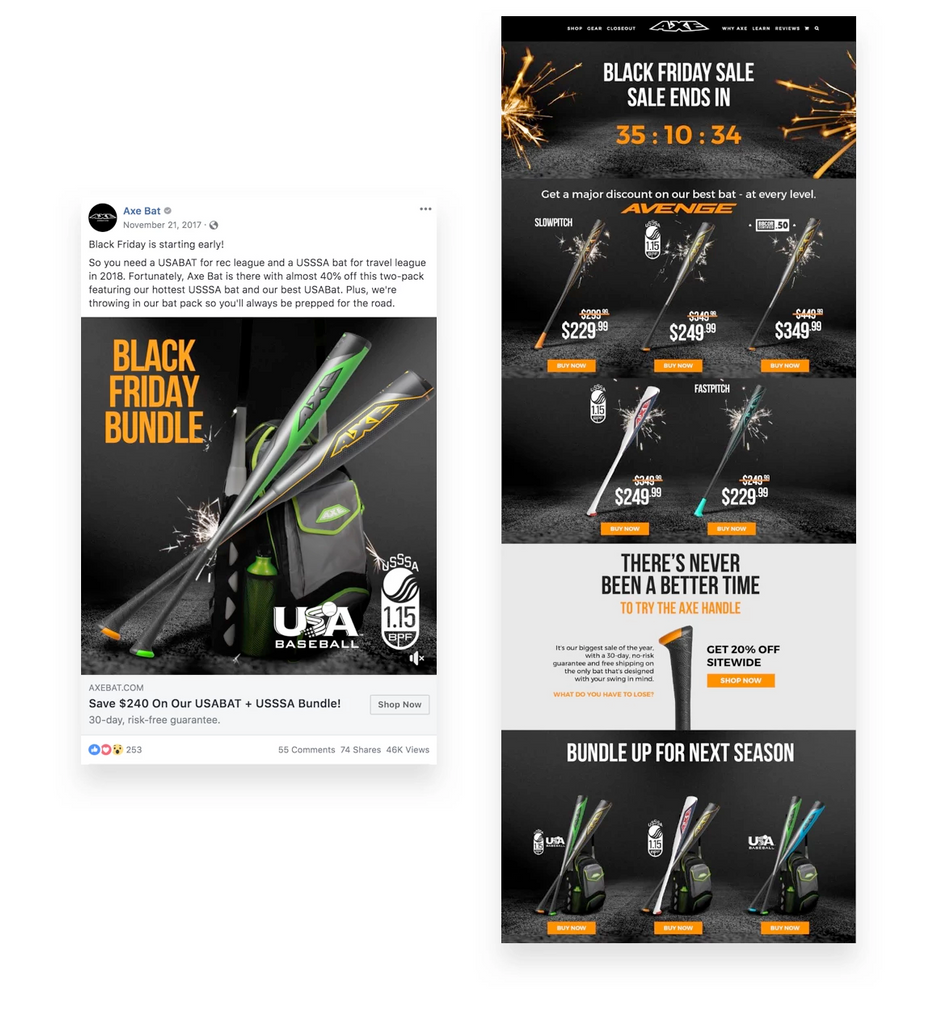
Offer customers a holiday deal they can’t get any other time of year. Uniquely bundle products and highlight the package with custom Black Friday branding. This can increase several key performance metrics even if the products you offer aren’t necessarily in-season.
For example, Axe Bat, an online baseball bat brand, combined a unique bundle with a custom holiday landing page as a case-study example of how a tailored offer and dedicated campaign page can improve holiday performance.
- Stronger return on ad spend
- Higher average order value
- More conversions
Once acquisition costs rise, retention channels often deliver more efficient holiday revenue.
Existing customer retention
Shopify has highlighted the long-term value of Black Friday Cyber Monday customer relationships, so the relationships you’ve already built with existing customers should be used to increase repeat holiday purchases.
Top five channels for existing customers
- Segmented email offers
- General email offers
- Retargeting for general site visitors
- Retargeting for product viewers
- Retargeting on social platforms

Email is often one of the highest-converting holiday channels for existing customers, especially when paired with strong segmentation and timely offers.
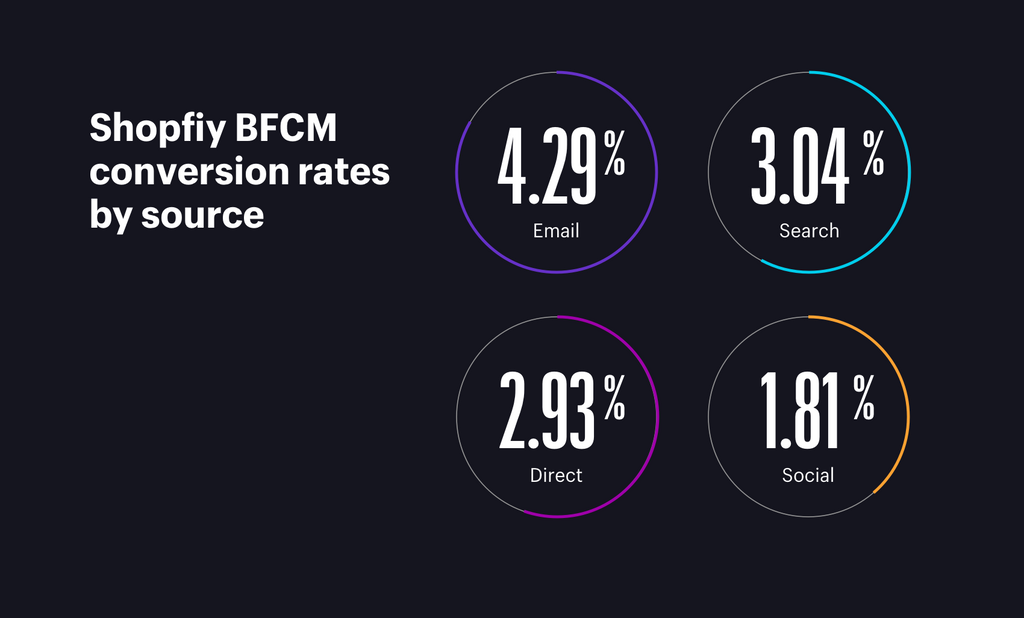
Segment email for higher holiday conversions
Maximizing email during the holidays requires segmentation. A practical framework includes:
- VIP customers: create a segment based on high lifetime value or repeat purchase count, then send early-access offers 24 to 48 hours before your main promotion.
- Recent engagers: target subscribers who opened or clicked in the last 30 days with your clearest holiday offer and strongest deadline messaging.
- Product viewers: trigger browse-abandonment emails featuring the exact category or product family a shopper viewed, ideally within a few hours.
- Cart abandoners: send a short recovery sequence with the exact items left behind, the active holiday offer, and a final reminder before the promotion ends.
- Lapsed customers: build a win-back segment for customers who purchased in a prior season but have not bought recently, and test gift-focused bundles or replenishment messaging.
A simple holiday flow might look like this: teaser email to VIPs on Wednesday, main launch email on Thursday night, cart recovery on Friday and Saturday, category-specific reminders on Sunday, and a final last-chance message on Cyber Monday.
For example, Shopify’s holiday marketing coverage has highlighted how brands use email segmentation to tailor Black Friday messaging for subscribers who opened earlier emails but had not yet purchased.
One practical approach is to send an extended or follow-up email to engaged segments that opened previous messages but did not convert, using a clear deadline and a focused offer.

Use retargeting to match customer intent
Immediately after email comes retargeting.
Because retargeting accounts for three of the top five channels, a practical takeaway is to make your ad experiences engaging and relevant to each customer based on where they are in their buying journey.
Stand out from the crowd by tailoring creative and sequencing to customer intent instead of repeating the same ad to every visitor.
A customer-journey retargeting approach can help you tell your brand story and build stronger emotional connections through more personalized retargeting experiences.
During the holiday season, use the influx in traffic to create intent-based segmentation in your retargeting and tailor your ads to customers at different lifecycle stages.
To keep your audience warm and stay top-of-mind leading up to Black Friday Cyber Monday, start your retargeting early so your audience can move progressively down the purchasing funnel.

Test emerging retention channels carefully
Importantly, it’s also useful to understand why some brands chose not to use certain channels in Shopify’s 2018 survey. In many cases, those decisions reflected budget limits, team maturity, channel fit, or platform limitations at the time rather than a universal recommendation to avoid those channels today.
Top five “will not use” existing customer channels
- Amazon remarketing: 84.3%
- SMS: 72.5%
- Direct mail: 70.6%
- Loyalty or rewards program: 58.8%
- Facebook Messenger: 52.9%
These figures are historical 2018 survey data. In particular, SMS has since become a mainstream retention channel for many brands, and Messenger’s role has changed significantly as platform features and consumer behavior evolved.
Be willing to test new channels. SMS and Facebook Messenger can be used to engage existing customers over the holidays, but only by treating them as designed. Use them sparingly to:
- Contact customers for whom you have strong behavioral profiles and can offer logical cross-sell opportunities
- Recover abandoned carts over Black Friday Cyber Monday
ShopMessage has been a game changer for Pura Vida. The abandoned cart flow through Messenger outperforms email and gives us a deeper relationship with our shoppers. I already recommend ShopMessage to every Shopify store owner I talk to.
— Griffin Thall, co-founder

In these examples, top-performing brands often share similar strategies and tactics, but your target market may react differently. Experimentation is key. Incorporate proven best practices, then adapt them to your audience.
Your holiday ecommerce marketing plan
The insights included here can supplement what worked well for your last holiday season. Key takeaways to incorporate include:
- Plan your holiday marketing and strategy early
- Prime new customers with pre-holiday PPC advertising that highlights offers that lift AOV
- Intelligently segment your email list and target existing VIP customers to maximize holiday sales
Build your holiday plan around three priorities: earlier audience development, stronger offer structure, and sharper retention segmentation. Start by mapping your campaign calendar, defining your highest-value customer segments, and testing bundles or tiered discounts before peak shopping weeks hit.
If you want a platform that helps you launch faster, personalize campaigns, and turn seasonal demand into repeat revenue, start building on Shopify today.
Read more
- Cash Flow Management Strategies
- How 3 Brands Scaled Their Ecommerce Subscription Model 100-350%
- What Conversion Experts Wished You Knew About Optimization
- Ecommerce Marketing Strategies: A Comprehensive Guide for Growth
- A Strategy for Human Resources in our Current Climate
- International Ecommerce Issues: How to Diagnose Global Barriers with Analytics
- Global Fulfillment: A Guide to Finding the Right Shipping Partner
- Hypefest 2018: O2O Examples from the Forefront of Marketing & Retail
- Native Advertising for Ecommerce: From Content Discovery to Scaling Sales
Frequently Asked Questions
What is a holiday customer acquisition strategy?
A holiday customer acquisition strategy is your plan for attracting new shoppers during peak seasonal demand using channels like paid social, paid search, and retargeting. The strongest strategies also connect acquisition to offer design, audience building, and post-click conversion goals.
When should you start planning holiday marketing?
You should start before Q4 whenever possible so you have time to build audiences, segment customers, and test offers before competition increases. Even if you start later, prioritize your campaign calendar, retention segments, and high-intent acquisition channels first.
Why is retention so important during the holidays?
Retention matters because acquisition costs often rise during the holiday season while AOV may not increase enough to protect margin. Email, retargeting, and personalized follow-up can help you generate more efficient revenue from shoppers who already know your brand.
How can you increase AOV during holiday campaigns?
You can increase AOV by testing bundles, tiered discounts, and free-shipping thresholds that encourage shoppers to add more items per order. Pair those offers with clear landing pages and ad messaging so customers understand the value immediately.
What are alternatives to paid social for holiday growth?
Alternatives include paid search focused on high-intent keywords, segmented email to existing customers, organic search, and retargeting based on site behavior. For many brands, these channels become especially valuable once paid social costs climb closer to peak shopping dates.


